Applications / Tree and nut crops
Water stress in tree and nut crops
Almonds, pistachios, walnuts and other permanent tree crops carry a season of committed cost in the ground before a single decision about water can be revised. This is the first application we are building for: continuous electrical measurement at the tree, tested against the reference methods growers already trust.
Our target: a two-week head start on drought stress. The comparative validation programme is being established; nothing on this page is presented as a demonstrated result.
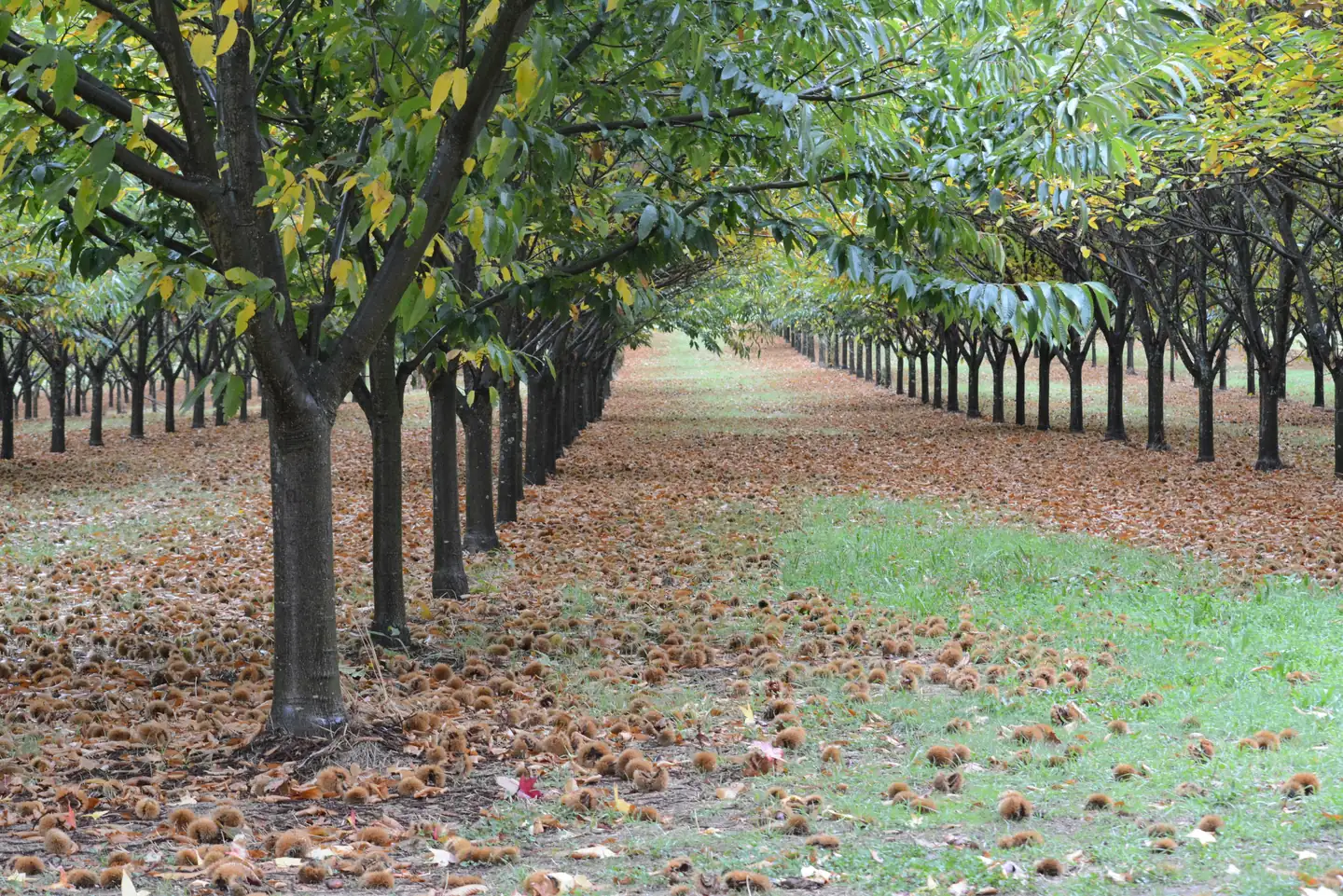
The grower's problem
In a permanent planting, water decisions are made against a tree that cannot be replanted this season. By the time canopy symptoms are visible in a block, the stress event is days or weeks old and the yield effect is largely fixed. Soil probes describe the soil rather than the tree, and a pressure chamber describes one tree at one moment. What is missing is a continuous reading taken at the plant itself.
Symptoms appear after the physiological event, not during it
Blocks are not uniform; a single probe rarely represents a zone
Reference measurements are accurate but labour-bound and intermittent
What is measured directly
Two identical electrodes, one placed in the xylem region of a living tree and one in the surrounding soil, record the electrical potential between them, continuously. The mechanism behind that potential was documented in company-sponsored research at MIT and published in PLoS ONE in 2008, which attributes it to the pH difference between the plant and its soil. The measured quantity is voltage. Its relationship to plant water status is an interpretation that is still being validated.
Directly measured: electrical potential, node microclimate, time. Inferred and under validation: plant water status, lead time over conventional monitoring.
Intended information and decisions
The intended service is a continuous time series per node, delivered through software and data subscriptions, with alerts on defined signal thresholds. The decision it is being built to inform is narrow and specific: whether to inspect a block and revise an irrigation set this week rather than next. We are not building an autonomous irrigation controller, and we do not replace the agronomist making the call.
Time series per instrumented tree, continuous rather than interval
Alerts on defined thresholds, with the reference measurement alongside
Block-level context that a grower reads with their existing data
Current evidence and its limits
The existence and magnitude of the plant-soil potential is established in peer-reviewed literature. Company-sponsored university research in 2016 and 2017 observed voltage changes preceding visible drought stress in a controlled study, and that observation is the basis of the two-week target. It is not a field proof of it. The size of any lead across species, sites and seasons, and the conditions under which it does not appear, is precisely what the current field programme has to establish.
Validation target, not measured result.
Alongside the methods already in use
| Method | What it measures | Cadence | Relationship to the tree |
|---|---|---|---|
| Soil moisture probes | Water content at fixed depths in the soil profile | Continuous at a point | Describes the soil the tree draws from, not the tree |
| Stem water potential (pressure chamber) | Leaf or stem water potential, the agronomic reference | Manual, typically weekly at midday | Directly at the tree, accurate, labour-bound and intermittent |
| Satellite indices (NDVI and similar) | Canopy greenness once it has changed | Revisit interval, weather dependent | Whole-block coverage, coarse resolution, describes the consequence |
| VoltreeAI node | Electrical potential between xylem and soil | Continuous at the tree | At the tree; interpretation as water status under validation |
What a field trial involves
A block of a permanent tree or nut crop with a known irrigation regime
Instrumented trees alongside the grower's existing soil and weather data
Reference measurements through the season, normally stem water potential
A defined comparison window and a pass threshold agreed before the season
Data shared with the grower, and results published whichever way they fall
Questions growers ask
- Does the sensor tell me when to irrigate?
- No. It is being built to flag an emerging change for investigation earlier than a visible symptom would. The irrigation decision stays with the grower and their agronomist, made with the reference measurements they already use.
- Is the two-week head start proven?
- No. It is a design objective and a validation target. Establishing it requires a stated crop and conditions, a comparison method and cadence, a definition of drought stress, and an observed lead time with its uncertainty. That programme is described on the Validation page.
- Does installing an electrode harm the tree?
- The electrode sits in the xylem region and the installation is small in scale, in the same family as a sap-flow or dendrometer installation. Long-term effects across species are part of what field deployments are monitoring.
- How does this compare with a pressure chamber?
- A pressure chamber is the agronomic reference and the trials measure against it. The difference is cadence: a chamber reading is one tree at one moment, and the node runs continuously. We are testing whether continuity buys useful time.
- Which crops are you starting with?
- High-value permanent tree and nut crops, where a season of committed cost sits behind every water decision. Viticulture and wildfire-risk applications are described on the applications overview at their own stage of validation.
Discuss an orchard trial
If you farm a permanent tree or nut crop and would host instrumented trees for a season, we would like to talk. Tell us the crop, the region and the irrigation regime.